VOYAGER 1 vs. VOYAGER 2
Two spacecraft, one mission — launched 16 days apart, now heading in opposite directions
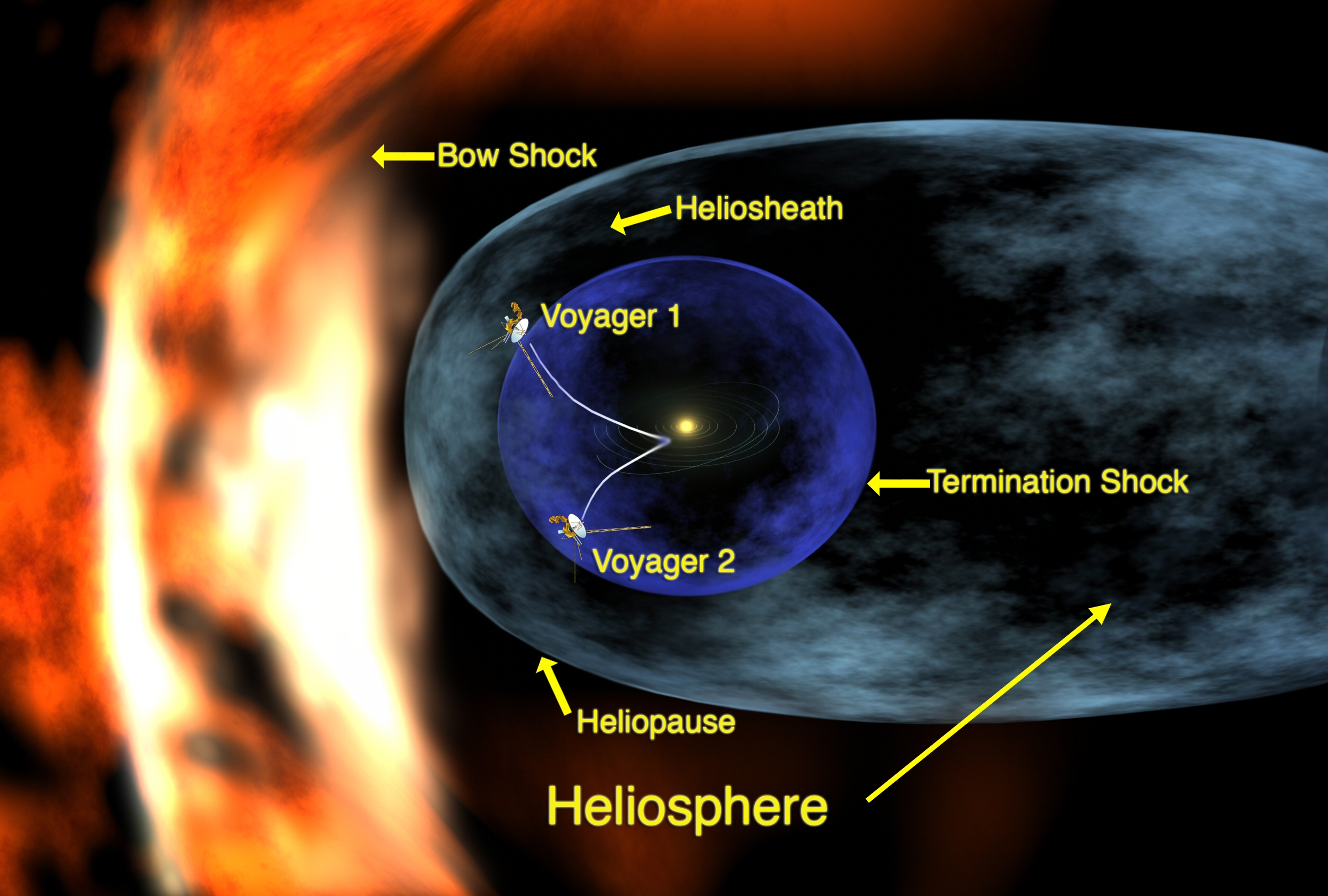

NASA launched two spacecraft as part of the Voyager program in the summer of 1977. Though they share the same basic design, their trajectories diverged dramatically after Saturn — sending them in opposite directions out of the solar system. Today, both spacecraft are in interstellar space and still communicating with Earth.
Side-by-Side Comparison
| Category | Voyager 1 | Voyager 2 |
|---|---|---|
| Launch Date | September 5, 1977 | August 20, 1977 |
| Launch Vehicle | Titan IIIE/Centaur | Titan IIIE/Centaur |
| Current Distance from Earth | ~24.4 billion km (163 AU) | ~20.5 billion km (137 AU) |
| Current Speed | ~17 km/s (38,000 mph) | ~15 km/s (34,000 mph) |
| Signal Travel Time | ~22.5 hours one-way | ~19 hours one-way |
| Direction of Travel | North of ecliptic plane | South of ecliptic plane |
| Planets Visited | Jupiter, Saturn | Jupiter, Saturn, Uranus, Neptune |
| Interstellar Space Entry | August 25, 2012 | November 5, 2018 |
| Power Remaining (approx.) | ~249 watts | ~249 watts |
| Status | Operational | Operational |
| Farthest Human-Made Object | YES (since 1998) | No |
The Grand Tour
Voyager 2 is the only spacecraft to have visited all four outer planets — Jupiter, Saturn, Uranus, and Neptune. This was possible because of the rare planetary alignment that occurs once every 175 years. Voyager 1 was given a faster trajectory aimed at a close Saturn/Titan encounter, which sacrificed its ability to continue to Uranus and Neptune. Voyager 2's Neptune flyby in 1989 remains the only close examination of Neptune in history.
Key Discoveries
Voyager 1 Discoveries
- Active volcanoes on Io (first ever seen beyond Earth)
- Jupiter's thin ring system
- Complex atmosphere of Titan
- First direct measurements of interstellar space
- The Pale Blue Dot photograph
Voyager 2 Discoveries
- Uranus has rings and 10 previously unknown moons
- Neptune's Great Dark Spot (a massive storm)
- Neptune's moon Triton has geysers of nitrogen
- First spacecraft to visit Uranus and Neptune
- Also entered interstellar space in 2018
Both Still Talking
Remarkably, both Voyager spacecraft remain in contact with Earth nearly 50 years after launch. NASA's Deep Space Network — a series of massive radio antennas stationed across three continents (California, Spain, and Australia) — continuously receives signals from both spacecraft. These transmissions, traveling at the speed of light, still require over 20 hours to reach Earth from Voyager 1's current position.
Every day that passes, Voyager 1 and Voyager 2 grow more distant and more silent. Both spacecraft will eventually lose sufficient power to maintain communication — NASA estimates this will occur around 2025-2030 for both vehicles. After that moment arrives, both spacecraft will continue their infinite journey through interstellar space in complete silence, each carrying a Golden Record as a message to the cosmos.