THE GOLDEN RECORD
● COSMIC ARCHIVE
A message from Earth to the cosmos — carried aboard Voyager 1 since September 5, 1977

A Copper Disk Bearing Humanity's Voice

Aboard Voyager 1 travels a 12-inch gold-plated copper disk — the Golden Record — perhaps humanity's most ambitious message to the cosmos. Conceived by a NASA committee chaired by astronomer Carl Sagan, the record was carefully assembled to represent life, culture, science, and music from Earth. It is a time capsule of our world, intended for any advanced civilization that might someday encounter the Voyager spacecraft in the depths of interstellar space.

The record contains 116 images selected to portray the mathematical and physical sciences, the geology of Earth, human anatomy, human civilization, and the diversity of life. It includes sounds of Earth — wind, thunder, animals, and human voices. Greetings have been recorded in 55 languages, from ancient Sumerian to modern Mandarin, each one saying "Hello" in humanity's own voice. And it carries music: 27 pieces spanning cultures and centuries, from Bach to Chuck Berry, from Azerbaijani folk to Peruvian panpipes.

The cover itself is a work of engineering and art. Engraved in aluminum, it bears a pulsar map showing Earth's location in the galaxy, instructions for playing the record encoded in binary, and the hydrogen spin-flip transition — the one constant that any sufficiently advanced civilization might understand. Within lies not just data, but a mirror held up to human experience and hope.

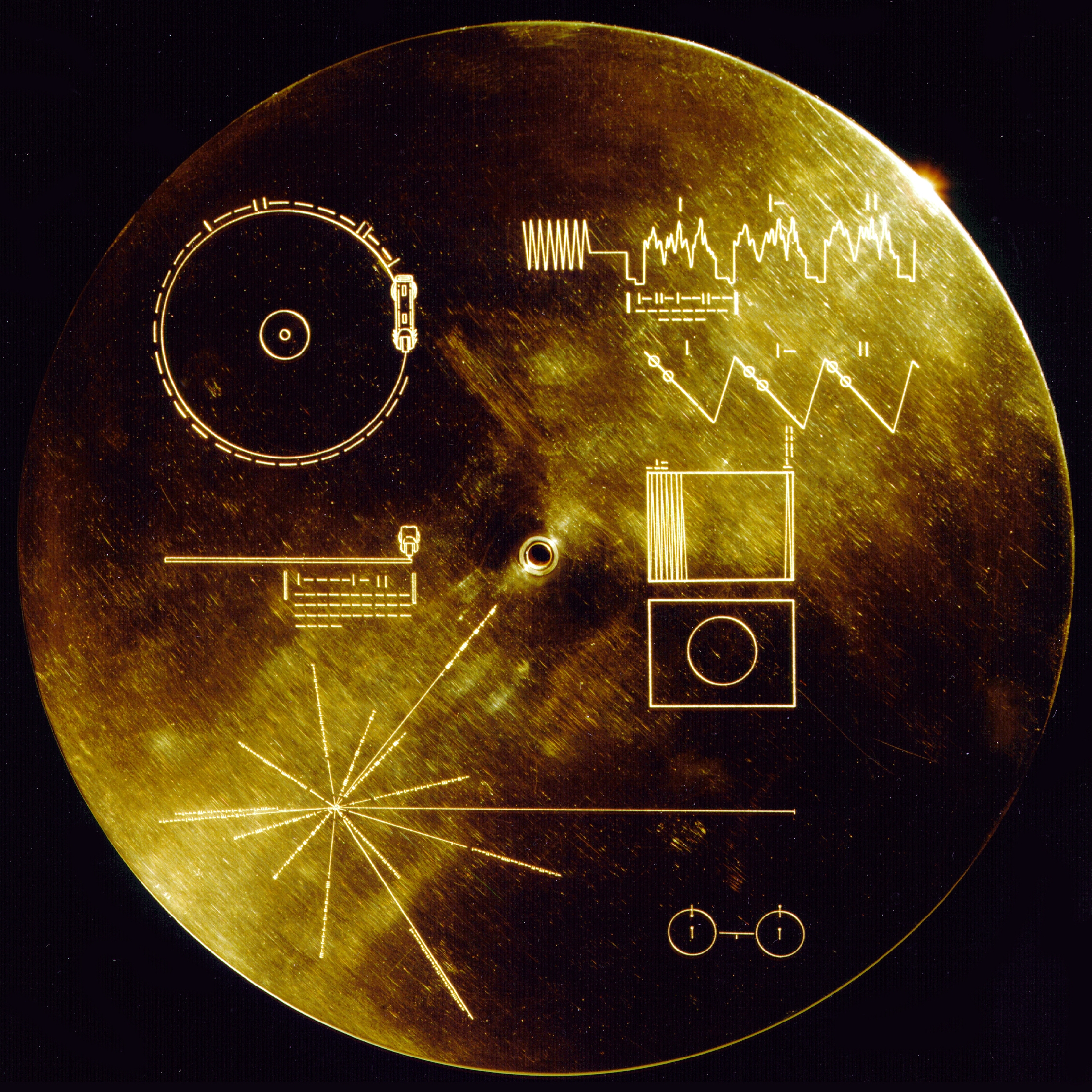
The Golden Record cover showing playback instructions
The Golden Record cover showing playback instructions encoded in binary. Image: NASA/JPL — Public Domain

Voices and Images Across Time and Space

55 GREETINGS

Greetings spoken in 55 languages, from ancient Sumerian to modern Mandarin. Each message says "Hello" — humanity's first and most universal gesture across time. The UN Secretary-General at the time, Kurt Waldheim, contributed a message on behalf of all Earth, welcoming any finder to our world.

116 IMAGES

116 photographs and diagrams encoded as analog video signals. They include mathematical definitions, the solar system and planets, DNA structure, human anatomy, food and agriculture, architecture, and landscapes from every continent. Images of children and families represent humanity at every stage of life.

NATURAL SOUNDS

The sounds that define Earth — surf breaking on shores, wind rushing through air, thunder, volcanoes erupting, rain, crickets chirping, frogs croaking, birds singing, and whales calling to each other across oceans. The final sound: a mother's first words to her newborn child.

MUSIC FROM EARTH

27 musical pieces representing the breadth of human creativity. Bach's Brandenburg Concerto No. 2. Beethoven's Fifth Symphony. Chuck Berry's "Johnny B. Goode." Indian classical. Azerbaijani folk music. Peruvian panpipes. Each piece a window into how humans make meaning through sound.

MESSAGES FROM EARTH

Words from world leaders and thinkers. President Jimmy Carter's message: a present from our small distant world to the large universe. The UN Secretary-General's greeting. These are humanity's ambassadors, speaking on behalf of our entire species across the cosmic void.

COVER INSTRUCTIONS

The aluminum cover holds a pulsar map — 14 pulsars chosen as cosmic landmarks, allowing any technological civilization to triangulate Earth's location. Instructions for playing the record are engraved in binary. The hydrogen spin-flip transition serves as the universal unit of time and length.

A Journey Into the Abyss

Voyager 1 now flies at the edge of the solar system, more than 24 billion kilometers from Earth — farther from our world than any other human-made object. The Golden Record has traveled across two decades into the void, past the orbits of the eight planets, past the Kuiper Belt of icy bodies, and toward the heliopause — the boundary where the sun's influence fades and interstellar space begins.

24+ Billion km
Current Distance from Earth

At its current velocity of approximately 61,000 kilometers per hour, Voyager 1 will not reach another star system for roughly 40,000 years. When it does, it will pass within 1.7 light-years of the star AC+79 3888 — close enough, in cosmic terms, to be considered a neighbor. By that time, the Gold Record's gold plating will have survived for over a billion years, protected in the frozen vacuum of deep space, awaiting discovery.

The record is not alone. Every component — the gold plating, the copper substrate, the encoded images and sounds — has been engineered to last. The disk was pressed to standards that should remain playable, and readable, for billions of years. It is, perhaps, humanity's greatest time capsule: a message in a bottle cast into an ocean of stars.

Earth's Cosmic Address

Engraved on the cover of the Golden Record is a map unlike any ever made on Earth — a map not of continents or countries, but of pulsars. Fourteen pulsars have been chosen as cosmic landmarks. Each pulsar's position and unique frequency is encoded in a pattern that radiates outward from a dot representing the Sun. Any technologically advanced civilization finding the record could use this map to locate Earth in the galaxy.

Pulsars are the most precise natural clocks in the universe — neutron stars spinning at regular intervals, emitting beams of electromagnetic radiation like cosmic lighthouses. Their frequencies are unique, and they change predictably over billions of years. A civilization with the knowledge to read pulsars would be able to triangulate Earth's position with remarkable accuracy, using only the constants of physics and the slow decay of stellar motion.

This is not a map that requires any shared reference frame with the finder. It does not depend on human conventions or measurements. It speaks in the universal language of physics itself — time, distance, radiation. It says: here is where we are, here is how you can find us, here is our address in the galaxy.

Humanity reached out across cosmic time and space not with weapons or declarations of supremacy, but with messages of peace, images of our world, and sounds of our music. The Golden Record represents a profound act of hope: the belief that the universe contains other minds, other civilizations, and that reaching across the void with a message of greeting is worth the effort, even if the message may never be received.

— The spirit of Carl Sagan's vision
■ THE RECORD IN PRODUCTION — 1977
Golden Record cover with binary playback instructions
The cover — binary instructions for playback etched in gold
The actual Golden Record disk
The 12-inch gold-plated copper disk itself
Golden Record being laminated and bonded, August 1977
Lamination and bonding — August 31, 1977
Mounting the Golden Record onto the Voyager spacecraft
Mounting the record onto Voyager before launch

Images: NASA/JPL — United States Government Works, Public Domain